


Absinthe

Episode 159: How Bad Science and a Greedy Wine Industry Transformed the "Green Fairy" Into the "Green Demon"
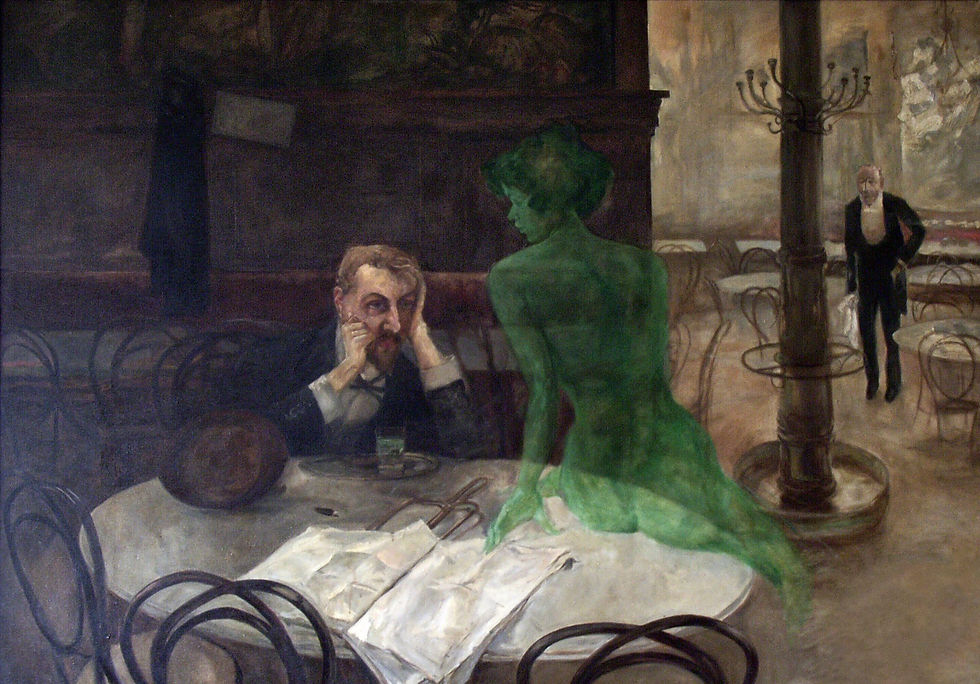
"The Absinthe Drinker" by Victor Oliva, 1901
Listen:
Watch:
Transcript:
It’s August of 1905 in the small village of Commugny, Switzerland. Jean Lanfray, a French laborer stands before three coffins, weeping. “Tell me I haven’t done this!” he sobs. “I loved my family. I would never do this.” In the coffins lay the bodies of his wife and two daughters, ages 6 and 2. Jean shot them all with his rifle after a day of binge drinking. At the trial, his defense paints a picture of Absinthe madness. They call in a psychiatrist who claims that only the absinthe Jean drank early that morning could have made him commit such an atrocious and inexplicable act of violence against his family. In the end, Jean Lanfray is convicted of 4 counts of murder. To add to the tragedy, an examination of his wife’s lifeless body showed she was pregnant with a son at the time she was killed. Jean will hang himself in prison 3 days later and his crime will go down in history as the “absinthe murder.” News of it will tear through Europe and travel to the United States, capturing public attention and outraging an already apprehensive crowd. In Commugny, where the crime was committed, the mayor will declare quote “absinthe is the principal cause of a series of bloody crimes in our country.” 82,000 signatures will be raised in just a few days and by 1910, Switzerland will become the first country to ban the contentious green drink altogether, followed shortly after by most of the western world. The green fairy will transform into the green demon, a scapegoat for the degradation of modern society. But what if I told you that Jean Lanfray didn’t stop at 2 absinthe drinks that day, early in the morning, diluted in water. During his lunch break he downed 6 glasses of strong wine plus another before leaving work that afternoon. On his way home he stopped at a cafe and had a black coffee with brandy. Then once he got home, he polished off a liter of wine, downing the last few drops just before murdering his entire family. The prosecution at his trial argued in vain that it was the excessive quantities of alcohol he had consumed, and not the absinthe, that caused such violent behavior. But decisions had already been made in the court of public opinion and absinthe was to blame. But where did those opinions come from? Was it just bad science? Or did money have something to do with it? Competition with a formidable wine industry perhaps? Let’s fix that.
Hello, I’m Shea LaFountaine and you’re listening to History Fix where I tell surprising true stories from history you won’t be able to stop thinking about. This topic was suggested by Hannah on Instagram. Keep the topic suggestions coming you guys. I promise I write all of them down even if I haven’t gotten to them yet in like literally years. I promise, if you’ve ever messaged me a topic idea, it is on a list. You can follow me on Instagram if you don’t already @historyfixpodcast. You can also email me historyfixpodcast@gmail.com. Those are probably the two best ways to get up with me. While we’re talking housekeeping, I released a not so mini mini fix last week over on patreon about the mysterious death of Amy Dudley, wife of Robert Dudley who was definitely a close friend of and may or may not have been a secret lover of Queen Elizabeth I. I say it’s not so mini because it ended up being over 30 minutes long. So it’s basically a full History Fix episode. Join me to get to the bottom of what exactly happened to Amy who was found dead at the bottom of a staircase in 1560 with a broken neck and two head wounds, one of which was 2 inches deep. Not sure how you sustain a 2 inch deep head wound after falling down 8 steps, but, you know, come join me on Patreon to ponder further. That’s patreon.com/historyfixpodcast, always linked in the description.
Onto today’s topic: absinthe. What exactly is absinthe? It is a beverage, of course, an alcoholic beverage, but what is it made out of and what sets it apart from other alcoholic beverages - liquors and wines and whatnot? Absinthe is mostly alcohol. It also has some spices and stuff in it, most notably, star anise and fennel which give it a licorice-y taste I don’t particularly enjoy but I guess people like. But what makes it absinthe and not just licorice flavored liquor, is one particular ingredient - an herb called wormwood, or artemisia absinthium if you want to get scientific. Absinthe has to be quite strong alcohol-wise. A percentage of 50 to 75% alcohol is required to keep the wormwood oil in suspension, like mixed into the liquid, not separated. So it’s a strong alcoholic beverage, like liquor. But the wormwood sets it apart. Wormwood contains a chemical compound called thujone. This is the psychoactive ingredient, like the THC of wormwood. THC is to cannabis as thujone is to wormwood. And, like THC, thujone affects the brain by inhibiting GABA receptors. But, let’s go ahead and get to the spoiler here. Thujone does not actually cause hallucinations. The idea that drinking absinthe causes hallucinations, or something similar to like doing a hallucinogenic drug like acid, LSD, is not true. That is a myth born out of paranoid public fear and disdain for absinthe and a bunch of slightly buzzed artists experiencing the placebo effect. Now, in super high quantities, thujone can cause convulsions and muscle spasms, seizures but, here’s the thing, in order to consume enough absinthe for that to happen, the convulsions, you would have consumed so much alcohol that you would actually die of alcohol poisoning before the thujone could do its thing. So, while absinthe stands apart from other liquors due to the thujone GABA inhibitor found in wormword, its version of THC basically, it is still mostly just a type of liquor with around 70% alcohol in it or 140 proof. Alright, got that myth out of the way early, now let’s talk about the history.
Use of wormwood goes back to ancient times. We know the ancient Greeks used it, because it shows up in the writings of Pythagoras, Hyppocrates, Pliny the Elder, Galen, etc. The Greeks had a sort of elixir they called absinthion (which is where the modern name comes from), that they made by soaking wormwood leaves in wine. So, pretty similar to modern absinthe. Except the Greeks were using it as medicine, not recreationally. It was used for all kinds of things - childbirth, menstrual pain, jaundice, anemia, rheumatism, bad breath, even a remedy for swooning. And then, after the Greeks, wormwood continues to be used medicinally. British herbalist John Gerard wrote in 1597 quote “Wormewood voideth away the wormes of the guts,” end quote. So we know it was used as a sort of anti-parasitic. We also know it was used during the 17th and 18th centuries in England to fumigate houses during outbreaks of bubonic plague. They would burn wormwood, kind of like how you might burn sage, to fumigate and cleanse the air of plague germs. Wormwood and sage are actually super similar. They are both part of the artemisia genus.
It wasn’t until the late 1700s that wormwood concoctions became a beverage in Europe - absinthe. The invention of modern absinthe is usually credited to a French doctor named Pierre Ordinaire in 1792. But, that can’t possibly be true because 23 years prior there was an advertisement placed in a Swiss newspaper by a Suzanne-Margerite Henriod advertising a remedy called “Bon Extrait d’Absinthe” which was made of alcohol, wormwood, aniseed, lemon balm, and some other herbs. Dr. Ordinaire just sort of adapts Suzanne-Margerite’s recipe and claims the fame as men are often wont to do in these fields and all fields really. One of my sources says that Suzanne-Margerite and her sister were Dr. Ordinaire’s housekeepers, but I can’t substantiate that. Anyway, Ordinaire becomes recognized as the creator of modern absinthe when he mixes 8 different plants, including wormwood, anise, hyssop, and fennel with 136 proof alcohol, so it’s 68% alcohol. Dr. Ordinaire’s concoction catches on big time in his French village as a sort of cure-all and it’s here that it gets the nickname the green fairy. Because absinthe is green. It’s this sort of light green color. That’s from all the green herbs in it, wormwood, but also hyssop, lemon balm, etc. And then fairy because it seemed to be this magical cure for a lot of ailments, right. This recipe gets passed on to a Major Henri Dubied who buys it from Ordinaire, or possibly from the Henriod sisters in 1797. And this guy, along with his son and son-in-law founded the Pernod distillery and started pumping out absinthe commercially.
In 1830, France conquered Algeria and sent in troops to man the new territory, as many as 100,000 troops by 1840. These French troops were completely miserable, serves them right stealing land that didn’t belong to them, but that’s neither here nor there. They were miserable with the climate, the heat, bad weather, fever tore through their ranks. And so they started giving the French troops in Algeria absinthe. It was supposed to help with the fevers, cure dysentery. They used it to disinfect the drinking water so they wouldn’t get sick from the water, which is probably why they had fevers and dysentery. But honestly, it was probably just the alcohol doing that, not the wormwood. Anyway, the French troops were digging the absinthe rations and when they returned to France they brought a taste for it with them. According to Jesse Hicks writing for Distillations Magazine quote “At first absinthe remained a middle- and upper-class indulgence. But it had an exotic appeal; legends grew about its long history and supposedly hallucinogenic effects. As prosperity spread, more people partook of l’heure verte, the “green hour” of early evening when the unique smell of absinthe wafted through the air. Savvy customers realized that with its high proof, absinthe delivered more force for the franc. Diluted with water (virtually no one could drink it straight), it went even further. By 1849 the 26 French absinthe distilleries were producing some 10 million liters, a small fraction of the prodigious amount of alcohol consumed in France,” end quote. 10 million liters sounds like a lot, but to put that in perspective, it was really just 3% of all the alcohol consumed in France. Just 3% of it was absinthe.
Then the artists got involved. Painters and poets began to view absinthe as this magical substance that liberated creativity and led to genius artistic breakthroughs. Manet, Degas, van Gogh, Picasso, to name a few. They all painted absinthe. Ernest Hemingway called it quote “opaque, bitter, tongue-numbing, brain-warming, stomach-warming, idea-changing liquid alchemy,” and said quote “It’s supposed to rot your brain out, but I don’t believe it. It only changes the ideas,” end quote. This is likely where the misconception that absinthe is a hallucinogen came from. These artists believed that it was having this really powerful effect on their minds, in much the same way that later groups of artists would use LSD’s hallucinogenic effects for like creative liberation. But, according to Adrienne Santos-Longhurst writing for Healthline, quote “As for some of the world’s most significant and innovative artists believing that absinthe gave them a creative edge? They were likely referring to the effects of early stage intoxication, which includes feelings of euphoria, excitement [and] self-confidence. Plus, according to various reports, many of the artists and writers who were inspired by the Green Muse also had a penchant for other mind-altering substances, including opium and hashish,” end quote. So, yeah, they were just kind of drunk. I feel like there’s definitely also some kind of placebo effect happening here. Like, they feel hallucination-y because they think they’re supposed to feel hallucination-y.
But, Hemingway’s quote there “it’s supposed to rot your brain out,” is a clue to what’s going on behind the scenes with absinthe, a twisting, a dismantling of public opinion. This started in the mental health community with a psychiatrist named Valentin Magnan (Mon-yon). Magnan was physician-in-chief of the Saint Anne mental asylum in France in 1867. This was France’s main asylum. It was the Bedlam of France, if you will. And so, in this prominent position, he became France’s national authority on mental illness. Now, Magnan was very concerned about what he believed to be a degeneration of the French race. He felt like mental illness was on the rise and that the once great nation of France was in decline because the people were unwell mentally. Now, that was probably mostly because people were being diagnosed with mental illnesses at a much higher rate than they once were due to the burgeoning field of medicine in the second half of the 1800s. Not that there were more mentally ill people, they just used to fly under the radar before that. But also, the strains of this new industrial life, long work hours, filthy living conditions in crowded cities, this all probably put a lot of strain on people mentally too. So, yeah, you’re going to see some fall out from that sort of a societal shift, that sort of lifestyle shift. But Magnon is sort of freaking out thinking France is going to hell in a handbasket because everyone is losing their minds.
So Magnon is becoming all paranoid about the degeneration of French people, because he’s working in a mental institution, at about the same time the anti-absinthe movement is kicking off and he begins to relate the two. He begins to blame absinthe for this degeneration. He coins the term absinthism as a condition distinctly different from alcoholism. Absinthism is basically alcoholism but with absinthe instead of alcohol. Nevermind the fact that absinth is roughly 70% alcohol. No matter. This is a completely different health concern. In 1869 he publishes the results of an experiment he did to try to prove that absinthe was dangerous to your health, more dangerous than just alcohol I should say. He put a guinea pig in a glass case with a saucer of pure alcohol. Then he put another guinea pig in a glass case with a saucer of wormwood oil. He also put a cat and a rabbit in glass cases with saucers of wormwood oil. So the glass case is sealed off, right, no fresh air, so they are breathing in either the alcohol or the wormwood. The guinea pig in the alcohol case just got drunk. The other three animals with the wormwood appeared to become excited and then they started convulsing, they started having seizures. Because of this, Magnon insisted that absinthe was different enough that it needed its own category and that it was dangerous enough that it should be banned.
Now, there are a lot of problems with this experiment which were pointed out right away. The main one being that the small animals in sealed glass cases inhaling the pure wormwood oil were quite different than a much larger human consuming a miniscule amount diluted in a large quantity of alcohol. Yes, wormwood, thujone can cause seizures in large quantities but these large quantities were not present in absinthe and could not be consumed, as I said earlier, without the consumer first dying of alcohol poisoning, we now know. Now if he had put pure alcohol in one saucer and absinthe in another, maybe that would have made more sense. But they don’t really understand that back in the 1800s and they don’t really know about like how to conduct a valid science experiment or anything like that. So Magnon publishes these results and it's enough to convince a lot of anti-absinthe people that the stuff is, indeed very dangerous.
Right after Magnon published his studies, 1870-1871 was the Franco Prussian war which France lost. And, for a lot of people this was proof of the degeneration of the French, this, what they called “poisoning of the population.” France was falling behind its enemies and more and more it was being blamed on absinthism. They believed absinthe was reducing the population and putting otherwise healthy virile Frenchmen, who could have been out fighting the Prussians, in the mad house. But it wasn’t until the absinthe murders in 1905, when Jean Lanfray killed his pregnant wife and two young daughters in a drunken rage that the final nail went into absinthe’s coffin. Hicks writes quote “Still, it took the Lanfray murders of 1905 to convert many citizens into activists. Previously the absinthe drinker symbolized moral decay, but he had never truly crystallized into a violent threat to society. Doctors disagreed about the danger, with Magnan and his disciples declaring absinthe the root of all social evil. On slim evidence some even linked it to tuberculosis. Meanwhile, other physicians continued to tout its health benefits, prescribing it for gout and dropsy, as a general stimulant of mind and body, as a fever reducer, and as the perfect drink for hot climates. Amid the medical uncertainty support for an outright ban remained a minority stance. After the Lanfray murders absinthe consumption became a serious political issue, as people throughout Europe—reading lurid headlines about the “absinthe murder” —demanded action,” end quote.
And somewhere around here the wine industry also got involved behind the scenes when wealthy wine producers supported banning absinthe for obvious reasons. Now, as I said earlier, absinthe only accounted for around 3% of the alcohol consumed in France. Wine accounted for something like 72%. Absinthe could not touch the wine industry but, you know, probably better to take it down anyway just in case. Back in the 1880s, some sort of plant disease had infected French vineyards leading to wine shortages. And, in the absence of wine, a lot of people had turned to drinking absinthe instead. Even after the wine industry bounced back, some of those people continued to drink absinthe because they had just acquired a taste for it. Still never more than 3% of alcohol consumed so, you know, not that many people, but the wine industry was not cool with people converting from wine to absinthe at all. It seemed to be the beginning of a possible trend that they very much did not want to continue and so they jumped behind the movement to ban absinthe. At the same time, Magnon had made this clear distinction between absinthism and alcoholism which allowed the wine industry to completely avoid any kind of blame for this poisoning of the people, this degeneration. All of it was blamed on absinthe. The irony of course being that it was actually the alcohol in the absinthe doing the poisoning, not the wormwood.
Switzerland became the first country to ban absinthe in 1910. If you remember, this is where Jean Lanfray murdered his family, in Switzerland. The US banned it in 1912. France banned it in 1915 spurred along by the vengeful wine industry. By the 1920s almost every country in Europe, except for Spain, Portugal, and England where it was never really that popular, had banned absinthe. Germany banned not only the sale of absinthe but also distribution of the recipe. The recipe itself was illegal.
It wasn’t until the 1970s, while absinthe was still banned, that we actually studied it like on a chemical level, like with actual science, not guinea pigs in glass cases. We looked at the molecular structure of thujone and what it actually does in the brain, that sort of thing. In a lot of ways it’s similar to THC. They have a similar molecular geometry, they are metabolized in a similar way in the human body, and they are both terpenoids, whatever those are, they are both that. And they both inhibit GABA receptors in the brain. So in the 1970s they sort of made this break through that thujone and THC were very similar. Later research proved that, while they do have all this in common, they actually do very different things in your brain, different effects, but, you know GABA inhibiting terpenoids nonetheless. In all of the research that has been done on thujone nothing at all suggests that it would cause hallucinations. It just doesn’t do that. It can cause convulsions and seizures in high quantities we know. So, you know 60 years post absinthe murders, almost a hundred years post Valentin Magnan now in the 1970s when this research started, they’re like, “what was all that poisoning and degeneration they were talking about?” And so, starting in 1991, countries in Europe started to legalize absinthe, make it legal again, produce it and sell it again. But they limited the amount of wormwood, of thujone, that could be in it. They figured, you know, if we go light on the wormwood we can avoid the degeneration they were experiencing back in the 1800s, early 1900s. They must have been putting way too much wormwood in there and people were having seizures or whatever. Cause seizures and murdering your family totally go hand in hand, right? So they limit the amount of wormwood that goes into modern absinthe. But, interestingly enough, they have since tested old absinthe, hundred year old samples of absinthe, the original pre-ban absinthe, and it has even less wormwood in it than the modern stuff. So, no the absinthe they were drinking back then was not causing seizures or hallucinations, definitively it was not. The US didn’t lift its absinthe ban until 2007 but absinthe in the US has to be thujone free. Despite the fact that we have proven the thujone in absinthe causes no ill effects whatsoever. Whatever.
So what was happening though? Why were people seeming to lose their minds and ruin their lives due to absinthism, this addiction to absinthe? How was it poisoning the population? Why did Jean Lanfray murder his family if it wasn’t the two shots of diluted absinthe he drank early that morning? Because, my friends, it wasn’t the trace amounts of wormwood being ingested by Jean Lanfray and the rest of the degenerates, it was the massive quantities of alcohol. Which, in hindsight, is pretty obvious. It didn’t help that they were using super poor quality alcohol to make absinthe. Hicks concludes quote “Many now believe it unlikely that thujone—at least in the small amounts found in absinthe—can have a toxic effect. What then caused the “absinthism” observed by Magnan and his colleagues? Some suggest that without strong regulation and quality control, such adulterants as copper sulfate, antimony, or chloride could have poisoned absinthe drinkers. And inferior alcohol, used by distillers eager to turn a quick profit, could also have led to impaired vision, for example. But the most likely culprit is perhaps also the most obvious: ethanol. The most prominent ingredient in absinthe after all is alcohol; maintaining wormwood in solution requires greater than 50% alcohol by volume. Stripped of its singular glamour and tabloid enchantments, “absinthism” looks like a much sadder and more common affliction: chronic alcoholism,” end quote.
So, I see major misconceptions rooted in bad science and a greedy wine industry spurred along by the adoption of absinthe by the artistic community, the counterculture if you will, which never helps the cause of any substance, no matter how harmless. It’s the same story over and over, a clear pattern emerges. If you listened to my episode about cannabis, episode 98, or my episode about LSD, episode 125, then you surely see the pattern. A naturally occurring substance once used with great success medicinally falls into the hands of creatives, whether its Black jazz musicians in New Orleans in the 1920s, tye dye wearing hippies in San Francisco in 1969, or impressionist artists in France in the 1880s and suddenly it’s blamed for every single problem that exists in society, the poisoning of the population, the degeneration, the rage, the murders, the insanity. I see a lot of parallels especially between absinthe and cannabis. Because cannabis was being blamed for murders and violence as well. They claimed it was making people go crazy and go on these like murder sprees and kill their families and that sort of thing. Very similar to the story of Jean Lanfray and the absinthe murders. Except we now know that the psychoactive ingredient in cannabis, THC, does not do this. It does not have this effect on the brain. Neither, we now know, does thujone, the active ingredient in the wormwood that’s in absinthe. These were the main, on paper, reasons these substances were banned, because they made people go crazy and murder their families. Except that’s completely false, scientifically disproven.
I find it really interesting, this court of public opinion that forms and the way the tiniest suggestion, like Magnon’s worthless experiments, can lead to a snowball effect, a witch hunt where something natural and actually very useful, cannabis, wormwood becomes so misunderstood and so feared by the people that we ban it, we make it illegal, so no humans can use it anymore. All of this spurred along of course by powerful entities with strong ulterior motives, like France’s wine industry, prodding an agitated bull. And in the end, the paranoia, the fear based misconceptions, have us so blind that we completely overlook common sense. That we ignore the 7 glasses of strong wine and an extra liter later plus a brandy drink that Jean Lanfray drank hours after the absinthe and just before murdering his family in a drunken rage before passing out in the front yard and waking up with no memory of any of it. Was it the absinthe? Or was it all of that? I’m always intrigued by the psychology of history and I find the psychology of banning things, of cancel culture really interesting and honestly pretty terrifying. Because it’s so often not based in common sense. It’s so often driven by fear and paranoia and ulterior motives, manipulation and trickery. So I guess the moral of the story is to keep your wits about you, right? Cling to common sense even when everyone else is drinking the koolaid. Actually, you go on and drink the absinthe, while everyone else is drinking the koolaid. How bout that?
Sources:


Comments